If you've ever walked into a jewelry store in Dubai — or browsed online for 18K gold jewelry — you've probably seen karats mentioned everywhere. 18K. 22K. 24K. But what do these numbers actually mean? And more importantly, which karat is best for the kind of jewelry you want to wear, gift, or invest in?
At ROKO Jewelers Dubai, we craft exclusively in 18K gold — and in this guide, we'll explain exactly why, breaking down the science, the aesthetics, and the practical realities of each karat so you can buy with total confidence.
What Does "Karat" Actually Mean?
A karat (abbreviated "K" or "kt") is a unit of measurement that describes the proportion of pure gold in a piece of jewelry. The scale runs from 0 to 24, where 24K represents pure gold — 100% gold, nothing else. Every number below 24K tells you how many parts out of 24 are pure gold, with the remainder being other metals called alloys.
These alloys — typically silver, copper, zinc, or palladium — are added intentionally. They change the colour of the gold, increase its hardness, and dramatically improve its durability for everyday wear. Pure 24K gold, while chemically impressive, is far too soft to hold gemstones, maintain its shape, or survive the demands of daily use.
The Karat Formula
To understand what your jewelry is actually made of:
- 24K gold = 24/24 = 100% pure gold
- 22K gold = 22/24 = 91.7% pure gold
- 18K gold = 18/24 = 75% pure gold
- 14K gold = 14/24 = 58.3% pure gold
- 9K gold = 9/24 = 37.5% pure gold
Each level represents a different trade-off between purity, durability, colour richness, and price. Understanding these trade-offs is the key to buying the right piece for your needs.
24K Gold: The Purest — But Not for Everyday Jewelry
24K gold is 100% pure gold. It has a distinctly deep, rich, almost orange-yellow colour that is unmistakably gold. It's the gold you think of when you imagine ancient Egyptian treasures or gold bars in a vault.
The Problem with 24K Gold for Jewelry
Despite its prestige, 24K gold is rarely used for wearable jewelry — and for very practical reasons:
- It's extremely soft. On the Mohs hardness scale, pure gold rates just 2.5, similar to a fingernail. It scratches, dents, and deforms with everyday contact.
- It can't hold gemstones securely. Prongs and settings crafted in 24K gold would bend and release stones with minimal pressure.
- It loses its shape. A 24K ring would become misshapen quickly just from the pressure of wearing it.
- It's very expensive. Pure gold commands a premium price that doesn't translate to lasting value in a wearable form.
24K gold is primarily used for investment bullion (bars and coins), gold leaf applications, and certain ceremonial or cultural jewelry pieces not intended for daily wear. In the UAE, 24K gold products are available at the Gold Souk, but they're purchases for value preservation, not for wearing.
22K Gold: High Purity, Limited Wearability
22K gold contains 91.7% pure gold, with the remaining 8.3% typically made up of silver and copper. It's the gold of choice for traditional Indian jewelry — intricate bangles, bridal sets, and ceremonial pieces — and it is also popular across parts of the Middle East for its deep golden colour.
Advantages of 22K Gold
- Deep, rich colour. The high gold content gives 22K pieces a vibrant, warm yellow tone that's immediately noticeable.
- High intrinsic gold value. With 91.7% gold content, 22K pieces retain strong resale value.
- Traditional preference. In South Asian and certain Middle Eastern cultures, 22K gold carries deep cultural significance.
Disadvantages of 22K Gold
- Still relatively soft. 22K gold scratches and dents more easily than lower-karat alloys, limiting its suitability for intricate, delicate designs.
- Not ideal for diamonds or gemstones. The softness means settings may loosen over time, risking gemstone loss.
- Higher price. You pay for the gold content, but you get less design flexibility and durability.
- Limited design precision. The softness restricts the complexity of designs that goldsmiths can achieve.
22K gold is a sound choice if you're buying jewelry primarily as a form of gold investment with wearability as a secondary consideration, or if you're purchasing traditional bridal jewelry for cultural occasions.
18K Gold: The International Standard for Luxury Jewelry
18K gold — 75% pure gold — is the benchmark for the global fine jewelry industry. It is the standard used by the world's most prestigious jewelry maisons: Cartier, Van Cleef & Arpels, Bulgari, and thousands of artisan jewelers crafting pieces designed to last lifetimes. And it is the only karat ROKO Jewelers uses.
Why 18K Is the Perfect Balance
The 25% alloy content in 18K gold is carefully calculated to achieve properties that neither 24K nor 22K can offer:
Durability for everyday wear
18K gold is significantly harder than 22K or 24K gold. This means it resists scratches and maintains its shape through the knocks and impacts of daily life — whether you're wearing a necklace to work, an earring to dinner, or a bracelet on a weekend in Dubai's heat and humidity.
Ability to hold gemstones and complex designs
The hardness of 18K gold allows goldsmiths to create intricate prong settings, pavé diamond work, and complex structural designs that would be impossible or unsafe in softer gold. If a piece has diamonds, emeralds, or any precious stones, 18K is the professional standard.
Colour versatility
By varying the alloy composition, 18K gold can be produced in yellow gold (our speciality at ROKO), white gold (alloyed with palladium or silver), and rose gold (alloyed with copper). This is why you see 18K gold in every colour of the rainbow of contemporary jewelry.
Long-term value and quality
An 18K gold piece that is well-made will last decades — potentially generations. The gold content is high enough to maintain intrinsic value, while the durability ensures the piece retains its beauty across years of wear.
18K vs 22K vs 24K: Side-by-Side Comparison
To make this easy to digest, here is a direct comparison across the key factors most jewelry buyers care about:
Purity: 24K (100%) wins on purity, but that's also its limitation. 22K (91.7%) is close behind. 18K (75%) has enough pure gold to be genuinely valuable without compromising on wearability.
Durability: 18K is significantly more durable than both 22K and 24K. For daily-wear jewelry, this is the most important practical factor.
Design complexity: 18K allows the most intricate designs and the most secure gemstone settings. 22K allows medium complexity. 24K cannot support detailed craftsmanship.
Price: 24K commands the highest price per gram, 22K is next, and 18K is more accessible — but you get more design, durability, and craftsmanship for your investment.
Ideal for: 24K suits gold investment and ceremonial pieces. 22K suits traditional bridal jewelry and cultural gifting. 18K is the choice for luxury everyday jewelry, statement pieces, gift-giving, and heirloom quality.
Yellow Gold vs White Gold vs Rose Gold in 18K
Once you've decided on 18K, the next choice is colour. ROKO specialises in yellow gold — and here's what sets each colour apart:
18K Yellow Gold
Yellow gold is the most classic and timeless gold colour. The alloy typically includes silver and copper, preserving the warm golden hue. It complements warm and olive skin tones beautifully, requires less maintenance than white gold, and retains its colour without re-plating. At ROKO, all our pieces are crafted in 18K yellow gold — the original, the authentic, the enduring.
18K White Gold
White gold is 18K gold alloyed with white metals like palladium or nickel, then typically rhodium-plated to achieve its bright silver appearance. It suits cooler skin tones and pairs well with diamonds. However, the rhodium plating wears off over time — usually within 1-2 years — requiring re-plating to maintain its white appearance.
18K Rose Gold
Rose gold's distinctive blush tone comes from a higher proportion of copper in the alloy. It has a romantic, vintage aesthetic and suits virtually all skin tones. Like yellow gold, rose gold doesn't require plating and maintains its colour permanently.
How to Identify 18K Gold Jewelry in Dubai
When buying gold jewelry in Dubai or online from UAE-based jewelers, look for these authenticity markers:
- The 750 hallmark stamp — This is the internationally recognised purity stamp for 18K gold (75.0% pure). Look for it inside rings, on the clasp of necklaces, or on the back of earring posts.
- UAE ESMA hallmark — Dubai requires all gold sold in the UAE to carry official hallmarking through the Emirates Authority for Standardization and Metrology (ESMA).
- Certificate of Authenticity — Reputable jewelers provide a certificate confirming the karat, metal composition, and any gemstone specifications. At ROKO, every piece comes with a Certificate of Authenticity.
Which Karat Should You Buy in Dubai?
The right karat depends entirely on what you want the jewelry for:
Buy 18K if you want:
- Everyday wear jewelry — rings, earrings, necklaces, bracelets for daily use
- Pieces with diamonds, emeralds, or other gemstones
- Intricate, contemporary, or fashion-forward designs
- A luxury gift that the recipient will actually wear
- Heirloom quality pieces designed to last decades
Buy 22K if you want:
- Traditional bridal gold sets for cultural ceremonies
- Jewelry with high gold investment value as a secondary benefit
- Large, solid, traditional designs without complex settings
Buy 24K if you want:
- Gold investment coins or bars
- Ceremonial pieces not intended for regular wear
- The absolute highest gold purity regardless of wearability
Why ROKO Jewelers Works Exclusively in 18K Gold
When we founded ROKO Jewelers in Dubai, the decision to work exclusively in 18K gold was not a cost consideration — it was an artistic and quality commitment. Our designs are characterised by structural complexity, precise gemstone settings, and forms that require a metal with the strength to hold its shape over years of wear.
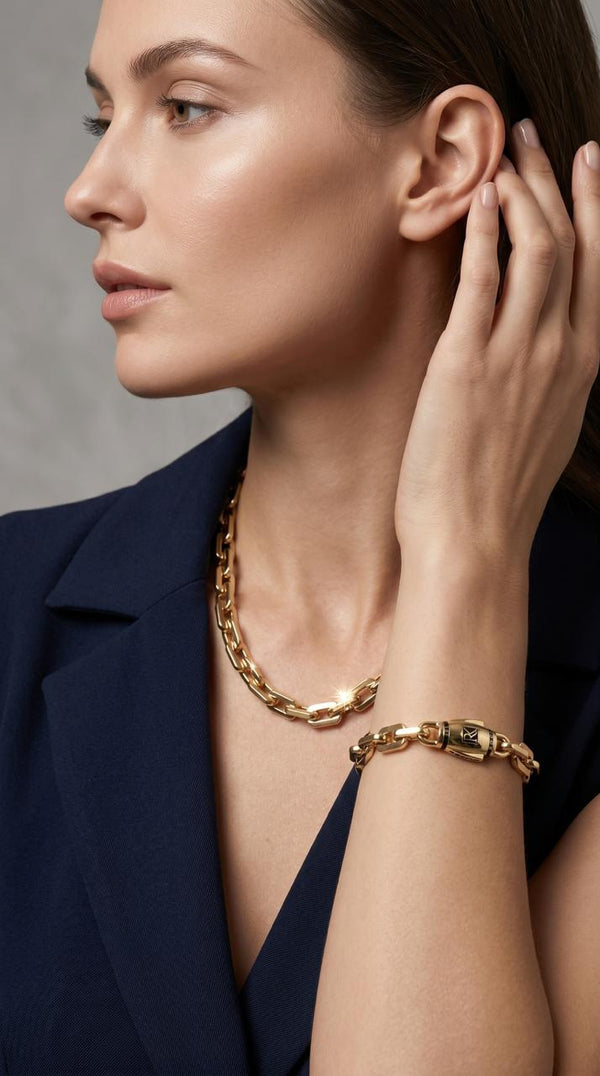
18K gold allows our craftspeople to achieve the intricate link patterns in pieces like our Unity Harmony Link Necklace, the delicate prong-set details in our earring collections, and the sculptural precision of our bracelet range — all while ensuring the pieces you buy today will look exactly the same ten years from now.
Every ROKO piece also comes with our Certificate of Authenticity confirming 18K purity, our 30-day return policy, and 3-day delivery anywhere in the UAE.
Frequently Asked Questions About Gold Karats in Dubai
Is 18K gold good quality?
Yes — 18K gold is the international luxury standard. It contains 75% pure gold and is more durable than 22K or 24K, making it ideal for everyday jewelry, gemstone settings, and intricate designs.
Which karat gold is best in UAE?
For wearable, lasting jewelry, 18K is best. For investment or traditional bridal gold, 22K is preferred. 24K is for bullion investment only.
How can I tell if gold is 18K in Dubai?
Look for the "750" stamp on the piece and ensure it comes with a UAE hallmark and Certificate of Authenticity. Legitimate retailers in Dubai are required by law to hallmark all gold jewelry.
Does 18K gold tarnish?
Yellow 18K gold does not tarnish. Over time, it may develop a patina from skin contact and daily wear, but this can be removed with gentle cleaning. Unlike white gold, yellow 18K gold does not require re-plating.
Is 18K gold worth buying as an investment?
18K gold jewelry has real gold value (75% pure), but its investment value is secondary to its beauty and craftsmanship. If pure investment is your goal, 24K bullion is more efficient. If you want a piece you'll treasure and wear daily while holding real gold value — 18K is the right choice.
Have a question about gold karats or ROKO's jewelry? Contact us directly or reach us instantly on WhatsApp at +971 50 157 3599. Our team in Dubai is happy to help you choose the perfect piece.